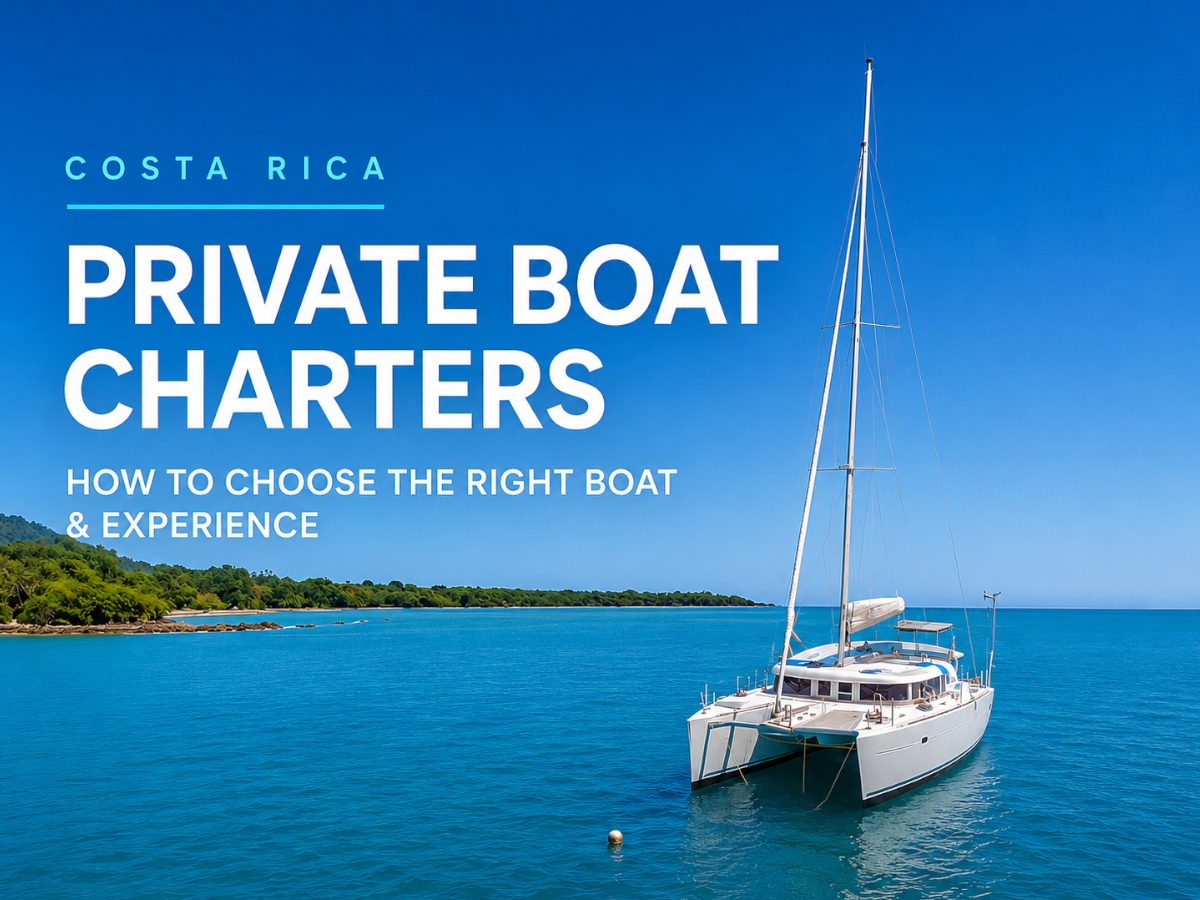
Costa Rica Private Boat Charters: How to Choose the Right Boat & Experience
How to choose the right boat, destination, and experience for your group.
There is no single “best boat” to charter in Costa Rica.
A beautiful 60-foot yacht can be the wrong choice for one group, while a smaller fishing boat or catamaran can create an unforgettable day for another.
After years working on the water in Costa Rica, this is probably the most important lesson we can share:
Choose the experience first. Then choose the boat.
Costa Rica’s Pacific coast offers everything from modern marinas and luxury yachts to remote tropical coastline, sportfishing, whale watching, snorkeling, sailing, and quiet beaches. But where you go, what boat you choose, and even how long you should stay on the water depends much more on your group than on what looks impressive in a photograph.
This guide is designed to help you understand those choices – and avoid some of the mistakes that are surprisingly easy to make when booking a private boat charter in Costa Rica.
What Is a Private Boat Charter in Costa Rica?
A private charter means reserving the boat for your group rather than buying individual spaces on a scheduled tour. The boat normally comes with a captain and, depending on the vessel and activity, additional crew.
But the biggest difference isn’t simply privacy. A good private charter can be built around your group.
A family with small children might want a half-day catamaran trip with plenty of opportunities to swim and play in the water. A group of adults interested in sportfishing may be much happier spending a full day offshore. Another group may care more about comfortable seating, food, music, and a beautiful stretch of coastline than doing activities at all.
That ability to personalize the experience is what makes private chartering valuable.
Before Choosing a Boat, We Ask Five Questions
When someone asks us to recommend a Costa Rica private boat charter, seeing which yacht they like is not our first priority. We would rather know:
Who is in your group?
How many people are traveling?
What do you enjoy doing?
What part of Costa Rica would you like to explore?
What is your approximate budget?
From those answers, we can begin working backwards toward the boat.
Exploring Options for Costa Rica Private Boat Charters
Age and physical condition matter too. A group of active adults interested in snorkeling, fishing, or exploring remote beaches has different requirements from a multigenerational family that values shade, easy access to the water, bathrooms, and comfortable places to relax.
We also try to understand where the group sits on the spectrum between comfort and adventure. There is no correct answer. The mistake is assuming the most expensive or luxurious boat is automatically the best one.
Where Are the Best Places for Private Boat Charters in Costa Rica?
Costa Rica’s Pacific charter destinations can broadly be divided into Guanacaste, the Central Pacific, and the South Pacific. Rather than choosing one region because someone says it is “the best,” consider the rest of your vacation. Ideally, your charter should complement the other experiences you want during your trip.
Guanacaste
Guanacaste offers some of the country’s strongest yacht and charter infrastructure, particularly around Papagayo and Flamingo. It is an excellent region for catamarans, motor yachts, sailing, fishing, sunset cruises, and family charters.
For families with children, we particularly like the combination of accessibility and boats designed around spending time in the water. Children often don’t want to spend six hours admiring the yacht. They want to jump off it.
A catamaran with easy water access, snorkeling equipment, paddleboards, floating mats, or inflatable toys can therefore be considerably more enjoyable for a family than a more expensive yacht that provides fewer opportunities to play.
Central Pacific: Herradura and Quepos
Herradura and Quepos are two of Costa Rica’s major boating hubs. Los Sueños Marina in Herradura and Marina Pez Vela in Quepos provide access to established fleets of yachts, catamarans, and sportfishing boats.
Herradura can be particularly convenient for family catamaran trips and groups traveling in the Central Pacific, while both areas provide access to Costa Rica’s well-known offshore fishing. Marina infrastructure can also make boarding easier for families, older adults, or anyone with limited mobility.
Uvita and Costa Ballena
Uvita offers a different type of experience. Unlike the major marina destinations above, Uvita does not have the same full-service marina setting; local boat experiences are closely tied to Marino Ballena National Park and the natural coastline.
What the region lacks in large-yacht marina infrastructure, it makes up for with nature. The Costa Ballena coastline remains intensely green, with forested hills reaching toward the Pacific and comparatively little large-scale coastal development. It is also an important area for humpback whale watching during migration periods.
For travelers primarily interested in wildlife and the natural coastline, Uvita can make much more sense than choosing a destination simply because it has larger yachts.
Golfito and Golfo Dulce
Golfito provides marina access in Costa Rica’s far south and is an excellent base for exploring Golfo Dulce and for sportfishing.
For the right couple, we would even choose a fishing charter from Golfito over the stereotypical “romantic yacht cruise.” Fishing gives you time together without needing to constantly do something – until a reel starts screaming.
Then suddenly you’re sharing the adrenaline of landing a fish together and, when appropriate and permitted, perhaps bringing back part of a sustainably caught food fish for dinner. Romance doesn’t always require champagne and a sunset. Sometimes it has a fishing rod.
Which Type of Boat Should You Charter?
Catamarans
For larger groups, families, celebrations, and events, catamarans are often one of the best options. Their wide beam creates large outdoor social areas, and many have easy access to the water.
But don’t judge a catamaran only by its overall length or certified passenger capacity. Look at where people can actually spend the day: how many guests can comfortably sit together in the cockpit, relax on deck, use the forward trampoline, and move around without constantly stepping over one another.
Motor Yachts
Motor yachts are excellent when comfort, privacy, speed, and amenities matter. Larger vessels may offer air conditioning, multiple bathrooms, cabins, kitchens, shaded decks, and spacious exterior lounging areas.
For a day charter, however, we pay particular attention to usable outdoor space. A beautiful interior photographs well, but most people didn’t come to Costa Rica to spend their day sitting inside a boat. Unless you are planning an overnight charter – or someone needs to rest indoors – the places where your group can sit, talk, eat, sunbathe, and enjoy the ocean usually matter more.
Sportfishing Boats
A serious fishing charter requires a boat designed around fishing rather than simply a boat capable of carrying fishing rods. The layout, equipment, electronics, crew experience, range, and fishing strategy all matter.
For adults specifically interested in fishing, a full day may make considerably more sense than trying to compress the experience into a short charter.
Smaller Motorboats or Pangas
Don’t overlook smaller boats. A smaller, well-maintained vessel can be the best choice for wildlife watching, snorkeling, coastal exploration, or reaching places where a large yacht would add cost without improving the experience.
Luxury is only useful when it contributes to what the group actually wants to do.
Legal Capacity and Comfortable Capacity Are Not the Same Thing
This is something almost no charter photograph tells you.
Imagine a boat legally certified to carry 22 passengers. Does that mean 22 people will enjoy spending the day aboard? Not necessarily.
A vessel can meet its legal passenger capacity while feeling extremely crowded when everyone wants shade, seating, food, access to the water, and room to move around.
Our question is different: How many people can actually enjoy this boat?
Sometimes our recommended number will be lower than the boat’s legal maximum. We would rather tell a client that before the charter than have everyone discover it once they are already aboard. Nobody books a private charter to spend the day packed together like sardines.
Don’t Choose a Charter From the Photos Alone
Every charter boat looks great in its best photographs. But boats operate in one of the harshest environments imaginable. Tropical sun, salt water, humidity, mechanical wear, and constant use take a toll.
A boat does not need to be cosmetically perfect to be safe, comfortable, and professionally operated. At the same time, there is a significant difference between normal wear and a vessel that has been neglected.
This is why we look beyond the listing. When possible, we consider the current condition of the vessel, maintenance, insurance, required documentation, onboard spaces, crew, and reputation.
And if something isn’t perfect, we believe the client should know. The objective isn’t to convince you that every boat we work with is flawless. It is to help you know what you’re booking.
The Right Boat With the Wrong Itinerary Is Still the Wrong Charter
We have seen this happen in real life.
A friend once booked a catamaran specifically because the group wanted the experience of sailing. There was one problem: they had chosen a region and time of year when there was very little wind. Instead of setting that expectation clearly, the charter was sold as though sailing would not be an issue.
The boat wasn’t necessarily the problem. The expectation was.
In another case, a family chose a catamaran expecting their children to spend time swimming. The itinerary took them to an area with heavy jet ski activity, making it difficult for the children to comfortably enjoy the water.
Again, the catamaran wasn’t necessarily wrong. The destination was wrong for that particular group. These are the kinds of details that are difficult to understand by scrolling through boat listings.
A Captain’s Minimum Qualification Is Only the Beginning
A good charter depends enormously on the people operating it. We look beyond whether someone meets the minimum requirements necessary to work aboard a vessel.
Experience matters. Local knowledge matters. Reputation matters. Additional training matters. And judgment matters.
Costa Rica’s boating industry includes operators with very different levels of experience and professionalism. For us, meeting the legal minimum and being someone we are comfortable recommending to a client are not necessarily the same thing.
This is one reason relationships within the local boating community matter. You learn who takes care of their boat, who takes care of their clients, who has developed a strong reputation, and who you are comfortable calling when your own client is stepping aboard.
Finding Wildlife Is About More Than Luck
One of the things that makes boating in Costa Rica special is the abundance of marine life. Depending on destination and season, you may encounter dolphins, humpback whales, rays, turtles, seabirds, and a huge diversity of fish.
But wildlife is wildlife. No responsible operator should guarantee that a whale or dolphin will appear on command.
Experience helps, but so does communication. Captains and crews talk to one another. Information moves around the water. Good equipment helps. Knowledge of seasons, conditions, and the area helps.
Together, those things improve the chances of finding activity. For us, one of the most important skills in creating a great day at sea is simply knowing where the life is happening.
Costa Rica Looks Different From the Water
There are many famous yachting destinations around the world with clearer water, larger marinas, or enormous fleets of superyachts. Costa Rica’s appeal is different.
The Pacific feels alive. And when you look back toward shore, particularly in less-developed areas, you often see green mountains and tropical forest rather than an uninterrupted wall of buildings.
The landscape is part of the charter. A dolphin encounter, a whale surfacing, a productive fishing spot, a quiet beach, or simply cruising alongside a green coastline can become more memorable than the specifications of the boat carrying you there.
That is why we don’t think a Costa Rica charter should be sold simply as a boat rental. The boat is the platform. Costa Rica is the experience.
What Is the Best Season for a Boat Charter in Costa Rica?
Costa Rica’s Pacific coast has a well-defined dry and rainy season. Official tourism guidance describes the Pacific dry season as December through March, with April as a transition month; the rainy season runs from May through October, with November as a transition month.
Rain during the Pacific rainy season tends to occur mainly in the afternoon and early evening, which is one reason morning departures can be particularly useful during greener months.
Conditions still vary by region and microclimate, so flexibility matters. We monitor forecasts as the charter approaches and try to communicate with clients when conditions look unfavorable. If weather or sea conditions genuinely make the planned experience a poor choice, rescheduling may be better than pretending everything will be fine simply because the boat has already been booked.
How Long Should You Charter a Boat?
There isn’t a correct answer. Once again, it depends on the group.
For a family with small children, a half-day may be perfect. Four enjoyable hours can be much better than stretching the trip until tired children stop having fun.
For a group of adults heading offshore specifically to fish, a full day may make much more sense. Distance matters too. So does the activity.
Instead of asking, “What is the standard charter duration?” ask: “How much time does our group need to enjoy what we came to do?”
What Should You Confirm Before Paying a Deposit?
Before sending money, read the cancellation policy. Then read it again.
In particular, understand how far in advance you can cancel and receive your money back without penalty. This becomes especially important with boating because weather and sea conditions can affect an experience.
You should also understand what happens if the operator cancels, what happens if conditions deteriorate, and whether rescheduling is possible.
Beyond cancellation terms, confirm what the price includes. Fuel, food, beverages, fishing equipment, water toys, park fees, transportation, and gratuities may be handled differently from one charter to another. A low advertised price is not necessarily a low final price.
A Note About Environmental Responsibility
We also pay attention to how operators treat the environment they depend on.
This does not require complicated sustainability slogans. Sometimes it starts with something as basic as reducing unnecessary single-use plastics during charter activities.
For a business built around the ocean, small operational choices repeated every day matter.
Platform vs. Local Yacht Broker: What’s the Difference?
Online charter platforms are useful. They can show you dozens or hundreds of boats, specifications, photographs, reviews, and prices in minutes.
But they generally begin with inventory: Here are the boats. Pick one.
Our approach begins from the opposite direction: Tell us about your group.
We want to know who is traveling, how many people there are, what you enjoy doing, where in Costa Rica you would like to go, and what you want to spend. Then we start looking at boats.
That difference matters because every boat owner understandably wants to sell time aboard their boat. Every captain will tell you what their vessel does well. And every boat looks good in carefully selected photographs.
A broker should be on the client’s side of that conversation. Sometimes that means recommending a different vessel. Sometimes it means suggesting fewer passengers than the boat’s maximum certified capacity. Sometimes it means saying that the sailing experience you want is unlikely under the expected wind conditions. Sometimes it means recommending a different itinerary so your children can actually enjoy swimming.
And sometimes it means simply saying: This boat is good, but here is what you should know before booking it.
Does Using a Yacht Broker Make the Charter More Expensive?
Generally, it shouldn’t.
Charter operators commonly compensate agencies and brokers with a commission. At Saltwater Connection, we negotiate rates with operators and aim to keep the price competitive for the client. In some cases, we may even share part of our commission to help make the charter more attractive.
And if you happen to find the same boat directly at a genuinely better price? Go for it.
We are not interested in convincing someone to pay more simply so a reservation passes through us. If you already have the boat but need help planning activities or understanding the area, we can still help.
Our value should come from helping you make a better decision.
Why Saltwater Connection?
Saltwater Connection exists because we genuinely like boats.
Our founder, Roberto Vargas, spent years working on the water as a scuba diving instructor. Becoming a yacht broker was a natural way to stay connected to boats, crews, and the ocean while helping travelers experience Costa Rica from the water.
That background influences how we look at charters. We don’t just see length, capacity, engines, cabins, and a gallery of photographs.
We think about how people will actually use the boat: Where will everyone sit? Can the children comfortably get into the water? Is there enough outdoor space for the group? Does this itinerary make sense? Is this the right season for what the client expects? Is the crew someone we are comfortable recommending? Is the boat currently being maintained? Are the insurance and required documents in order?
And perhaps most importantly: Would we put our own friends aboard?
Choose the Experience. Then Choose the Boat.
A private charter can be one of the most memorable days of a Costa Rica vacation.
But you don’t need the biggest yacht. You don’t necessarily need the most expensive one. And you definitely don’t need to choose from hundreds of boats hoping you picked the right one.
Start with the people who will be aboard. Decide what kind of day you want to have. Consider where that experience makes the most sense. Then find the boat and crew capable of delivering it.
That is how we believe yacht brokerage should work.
Your needs should choose the boat – the boat shouldn’t choose your experience.
Frequently Asked Questions
How much does a private boat charter cost in Costa Rica?
There is no useful single average because a short trip on a smaller motorboat and a full-day luxury yacht are very different products. Vessel type, duration, fuel, crew, destination, food, fishing equipment, water toys, and marina all affect price. A broker can narrow the options once the group, area, activities, and budget are clear.
What is the best place to charter a yacht in Costa Rica?
It depends on the rest of your trip and the experience you want. Guanacaste offers strong marina and catamaran infrastructure; Herradura and Quepos are convenient Central Pacific hubs with excellent fishing access; Uvita is especially attractive for nature and seasonal whale watching; and Golfito is a strong base for Golfo Dulce and fishing.
Is a catamaran or motor yacht better for families?
For many families, especially larger groups or those with children who want to swim, a catamaran can be an excellent choice because of its usable outdoor space and easy water access. A motor yacht may be better when speed, privacy, air-conditioned interiors, and higher-end amenities are the priority.
How long should I charter a boat in Costa Rica?
Match the duration to the group and activity. A half-day can be ideal for families with young children, while adults heading offshore to fish may benefit from a full day.
What should I check before booking a private boat charter?
Confirm the cancellation and refund policy, what the price includes, the current condition and comfortable capacity of the boat, and the experience and reputation of the crew. Insurance and required operating documentation should also be current.
Do I pay more by booking through a yacht broker?
Not necessarily. Charter operators commonly pay brokers or agencies a commission. Saltwater Connection aims to keep client pricing competitive and focuses on helping the client choose the right vessel and itinerary rather than simply adding a markup.
Plan Your Costa Rica Private Charter
Tell us five things: who is traveling, your group size, what you enjoy doing, the area you would like to visit, and your approximate budget. We’ll help narrow the options and recommend a boat and itinerary that fit the experience you actually want.
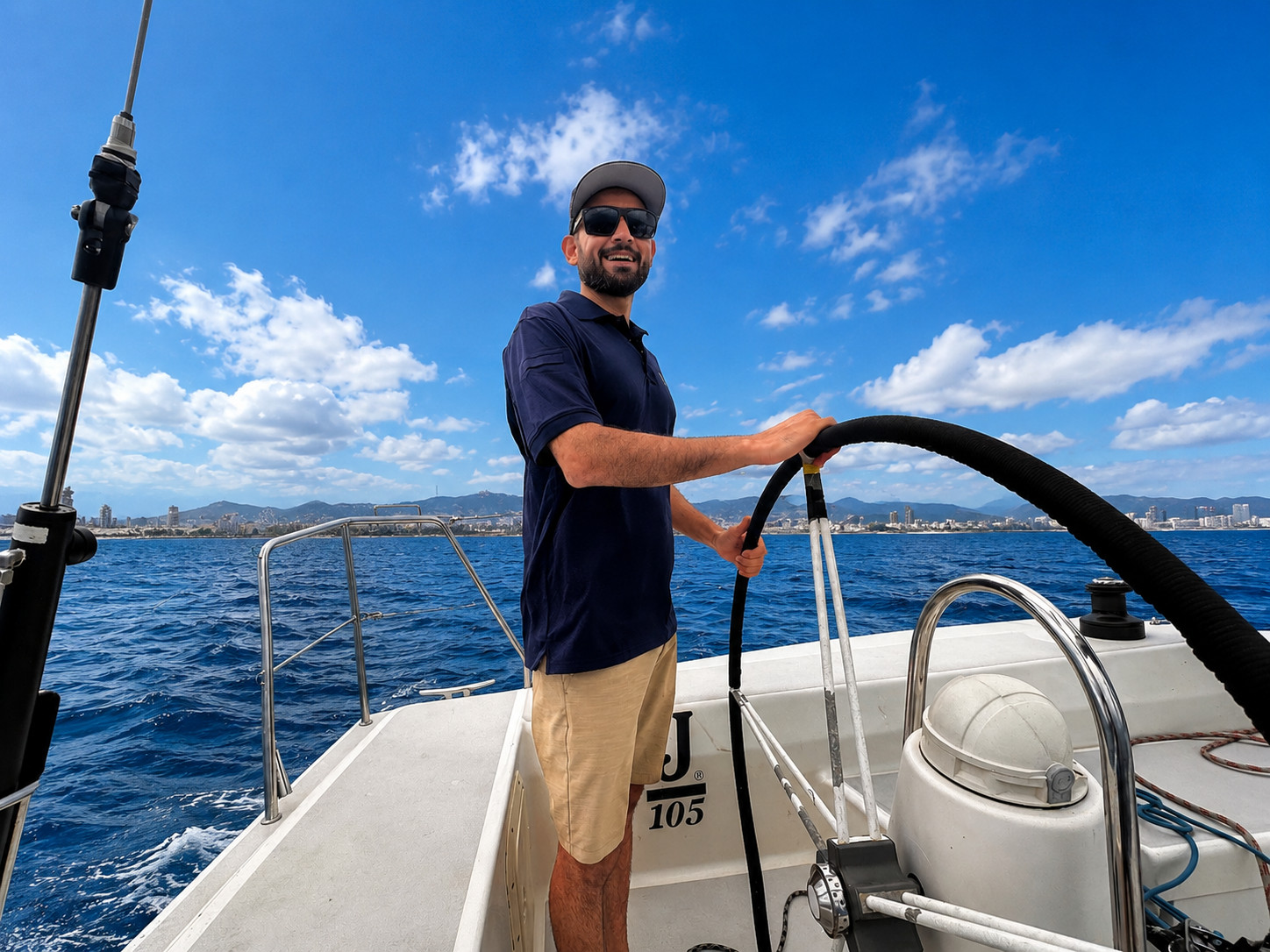
Costa Rican diving professional, sailor, and co-founder of Saltwater Connection. With 18+ years exploring Costa Rica’s coast and sailing different seas, he shares his passion for the ocean through authentic adventures.

